She Was Also Born That Day
₹895 · free delivery in India
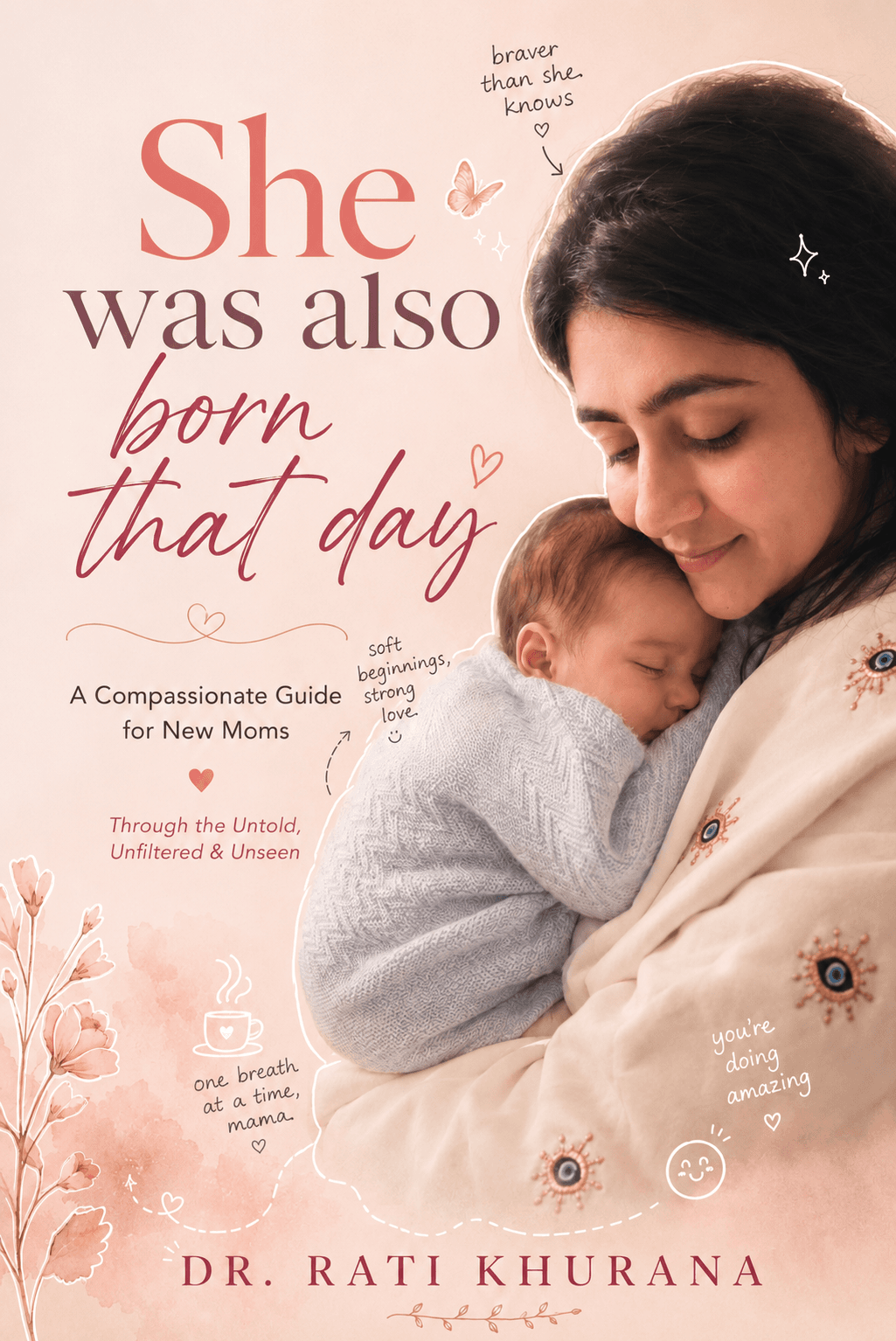
Shewas alsoborn that day
A Compassionate Guide for New Moms
Through the Untold, Unfiltered & Unseen
A book about the woman who was also born the day her baby was. Written by Dr. Rati Khurana — clinical psychologist, PhD, RCI licensed — and a mother who went through the fourth trimester herself.
The author’s proceeds from this book — her publisher royalties and the margin on every copy sold here — are donated.
Packed and posted by hand. Ships within India.
PhD Clinical Psychology
RCI licensed · Beck Institute (USA) certified
Synergy Books India
ISBN 978-93-92958-49-6
The author’s proceeds from this book — her publisher royalties and the margin on every copy sold here — are donated.
Smile Foundation · United Nations Foundation · Impact India Foundation
Replaced or refunded
If it arrives damaged, within 7 days
What this book is about
The baby finally went down forty minutes ago.
You are awake anyway, listening for breathing.
Your phone is at eight percent.
You have typed the same three things into it before.
is this normal after having a baby
why don’t i feel what i’m supposed to feel
how long does this last
This book was written by someone who was awake at the same hour, asking the same thing.
you are not failing
What is happening to you has a name
It is called matrescence — the birth of a mother. It is as real, as physical and as documented as adolescence, and almost nobody in the room will name it for you.
The steepest
hormonal drop a human body goes through
Progesterone and oestrogen fall from pregnancy levels to almost nothing within days of the placenta coming out. Nothing in puberty or menopause is this abrupt.
A brain
physically rebuilding itself
The regions handling emotion, reward and threat are reorganising so you wake at a sound nobody else hears. That is not anxiety. That is the rewiring working — at the cost of a mind that cannot switch off.
90 minutes
the longest sleep you are getting
And you are healing from a delivery or major abdominal surgery while you do it, often feeding every two hours.
If you did any one of those three things you would not be yourself either.You are doing all three at once.
A mother births herself at the same time as her child.
the honest reason
Why this book exists
nobody asked me
Because every question was about the baby
Feeds, weight, jaundice, sleep. A hundred questions a day, and not one of them about the woman who had just been through it. Dr. Khurana went through her own fourth trimester as a clinical psychologist who knew exactly what was happening to her — and still could not say it out loud.
not a Western book with an Indian cover
Because the books that existed were not written for this house
Joint families. Mothers-in-law with forty years of certainty. The chilla. Log kya kahenge. Ghutti and honey. These are not footnotes to be added to an American postpartum guide — they are the architecture of an Indian mother’s first year, and this book is built on them from the ground up.
permission, not instructions
Because what most mothers need first is permission
Permission to not feel the rush of love on day one. To be furious. To grieve the person you were. To use formula. To need help, and say so. The book is a psychologist’s book, but its deepest function is simply to say: you are allowed.
read a little of it first
In her own words
from chapter two
The mirror moment
One of the hardest moments a new mother often faces is the mirror moment. The moment when she finally gathers courage to walk to the mirror with the intent of tidying up her hair or applying some moisturizer — but who does she really see?
She sees a version of herself that she never saw before and wasn't warmed up to. She sees herself as the finished product of bringing a life into the world, who is now not the most essential, as her job of birthing is over.
But is this really a new normal that she has to live with — or just a body in transition that she has to be attuned with?
Approximately 52–63% of women report negative views about their postpartum bodies. It is totally normal to not instantly be comfortable with a body that you haven't seen before. But it is important to remind yourself that the body you are seeing also just gave you a gift of life, and for that it did take a huge toll on itself.
If you read that and thought she has seen me — that is the whole book.
Order your copyThe way through
Ten chapters, in the order the year actually happens — not the order a textbook would put them in.
The beginning
The caesarean, the bond that did not arrive on cue, and the difference between failing and feeling.
Beyond the baby blues
Where the first fortnight ends and something else begins — depression, anxiety, and postpartum OCD.
But why does it feel so intense?
The rewiring brain, the hormone cliff, and sleep measured in ninety-minute fragments.
Sometimes love can co-exist with opinions and unsolicited advice
In-laws, your own mother, your partner, and forty days of rules nobody explains.
Real mothers make a choice
Feeding — supply, mastitis, D-MER, ghutti, and the guilt manufactured around all of it.
Every mother’s journey is different
Whose life you walked into motherhood carrying, and the comparison the feed feeds you.
Healing isn’t linear and doesn’t have to be perfect
Kintsugi, the grief for the woman you were, and asking where to instead of where from.
Finding yourself again with the strength you thought you never had
Survival mode, and the growth that happens in spaces too small to photograph.
You won’t have to carry it all by yourself
Why mothers say "we’re doing good", and how to actually ask. Includes a mental-health first-aid kit.
A letter to all the mothers who are struggling and still choosing to show up
The keepsake pages, and a letter that ends simply: Love, Rati.
What you are left holding
By the last page
Language for what you are feeling
So you can say it to your husband, your mother, or a doctor without having to perform being fine first.
A clear map of ordinary versus not
What the fourth trimester does to everyone, and the specific signs that mean this needs more than a book — written by a clinician, not a forum.
Permission to stop performing
To not feel the rush on day one. To be furious. To grieve who you were. To use formula. To need help and say so out loud.
This book was never meant to earn anyone anything
The author’s proceeds from this book — her publisher royalties and the margin on every copy sold here — are donated.
Not a marketing line — the reason it was written. Every copy you buy goes on to support the organisations below.
Smile Foundation
An Indian development organisation working in health, education and livelihood for children and families.
Smile FoundationUnited Nations Foundation
Supports United Nations work on global health, including maternal and newborn health.
United Nations FoundationImpact India Foundation
An Indian public-health foundation working on preventable disability and community health, including maternal and child health.
Impact India FoundationOrganisation names link to their own websites so you can verify them independently.
this one is for you if…
Who it's for
- You are in the first year after having a baby, and nobody warned you it would feel like this
- You love your baby and still feel you have lost yourself
- Your house is full of people and you have never felt more alone
- You had a caesarean, a hard delivery, or a birth that went nothing like the plan
- You are a partner, a mother, or a mother-in-law who wants to understand what she is going through
- You work with new mothers — as a psychologist, obstetrician, nurse or doula
who wrote it
Dr. Rati Khurana
PhD in Clinical Psychology and an RCI-licensed rehabilitation practitioner based in Gurugram. Certified in CBT by the Beck Institute, USA, in Positive CBT, and as an EFT practitioner. Winner of the Beck Institute's Outstanding Doctoral Research Award in Asia (2024).
She is also a mother. The book came out of both, and neither half would have been enough on its own.
More about Dr. Khuranaand if the book isn't enough
Some things a book cannot do
A book can tell you that you are not the only one, and that alone changes a great deal. What it cannot do is look at your particular house, your particular birth and your particular family and tell you what is actually happening.
Dr. Khurana sees mothers online across India — the same voice you have been reading, in a room with only you in it.
Buying for a hospital, clinic, college or team?
Copies for maternity wards, antenatal programmes, counselling departments, libraries and returning-parent programmes are arranged directly. Tell us roughly how many and we will come back with terms.
before you decide
Questions people ask
No. It reads like a friend talking to you at 3 a.m., not a textbook. The science is woven into plain language, there are no clinical tables inside the chapters, and most people finish it in two or three sittings.
Not at all. Postpartum depression can begin any time in the first year, and a great deal of what the book covers — the grief for who you were, in-law dynamics, the guilt — does not expire at twelve months. Plenty of what mothers carry from that year is still being carried years later.
Yes, and that is most readers. The book is not a treatment manual. It is a companion for the fourth trimester, and much of it is simply permission — to feel what you feel without deciding first whether you have earned the right.
That is one of the commonest reasons people buy it. Ask for a signed inscription at checkout and it arrives as a gift rather than a diagnosis. The family chapter is written with the family in the room, not against them.
Yes. The author’s proceeds — her publisher royalties and the margin on every copy sold on this site — are donated. The organisations are named on this page and linked to their own websites so you can look them up yourself.
Dispatched in 3-5 working days once payment is confirmed, then roughly 4-8 working days in transit depending on your PIN code. The book ships within India only, and tracking is emailed when it goes out.
Then that is worth knowing, and it is not a failure of the book. Dr. Khurana sees clients online across India. If reading it makes you think you would rather talk to someone, the free postpartum self-check takes three minutes, or you can book a consultation.
you're doing amazing
A book can keep you company.
Sometimes you need more than company.
If what you have read here feels a little too close to home, that is worth a conversation. Online postpartum support is available across India.
Your baby was born that day.
So were you.